
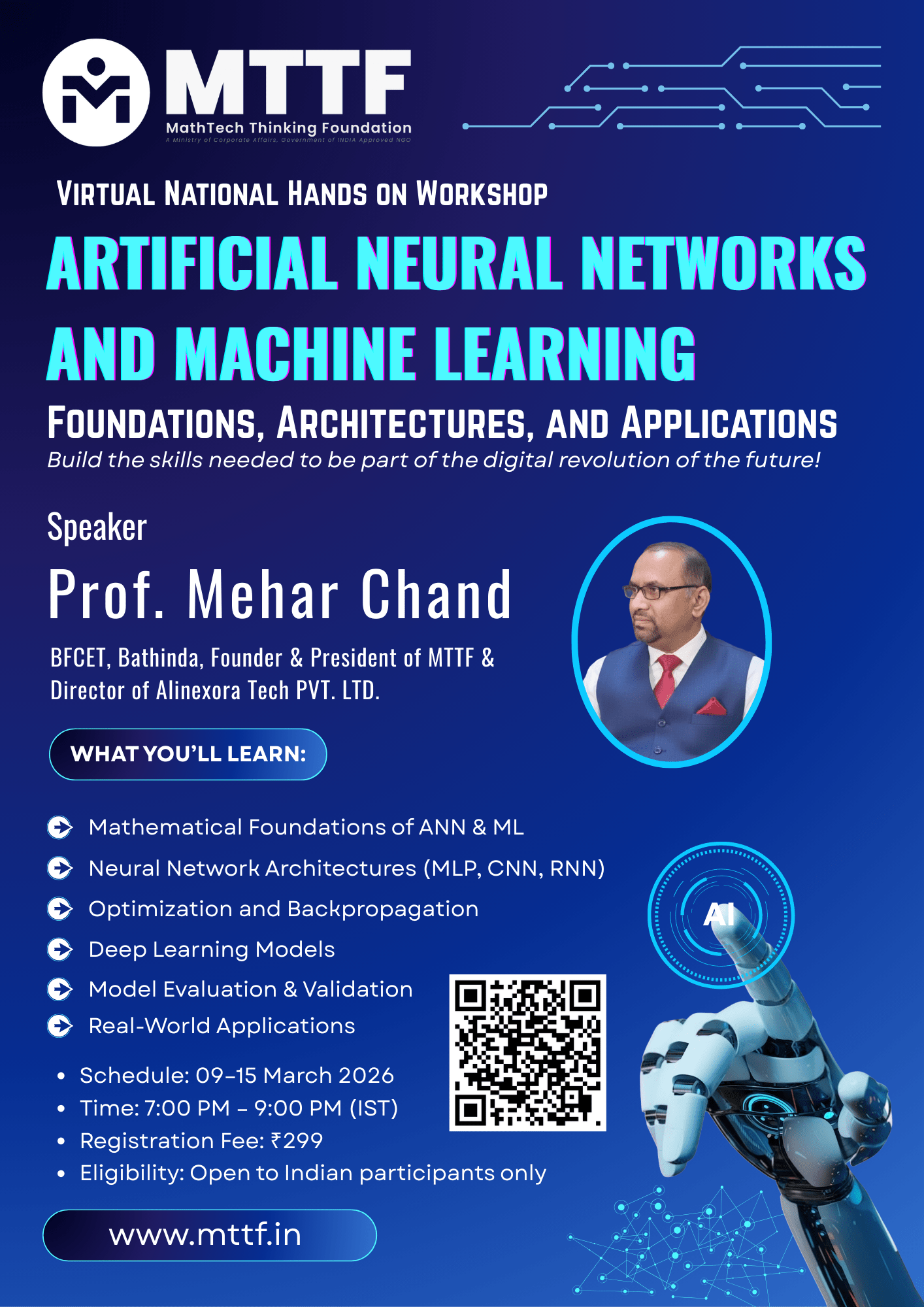
Virtual National Hands on Workshop on Artificial Neural Networks and Machine Learning
Event Description
Workshop Schedule
-
Dates: 09–15 March 2026
-
Duration: 7 Days
-
Time: 07:00 PM – 09:00 PM (IST)
-
Mode: Virtual (Online)
-
Seats: Limited (early registration recommended)
Registration Fee
-
National Participants: ₹299 INR
About the Hand-on Workshop
This hands-on workshop provides a structured and practical introduction to Artificial Neural Networks (ANN) and Machine Learning (ML), integrating mathematical theory with real-world implementation. The program is designed to help participants understand how intelligent systems are built, trained, optimized, and deployed across various domains. The workshop begins with the mathematical foundations of machine learning, including linear algebra, probability, optimization, and gradient-based learning. It then progresses to core neural network architectures such as Multi-Layer Perceptrons (MLP), Convolutional Neural Networks (CNN), and Recurrent Neural Networks (RNN), along with deep learning frameworks and evaluation techniques. Through guided coding sessions and case-based demonstrations, participants will gain practical exposure to model development, training, validation, and performance tuning using modern AI tools and platforms. Applications in healthcare, finance, agriculture, and smart systems will be discussed to connect theoretical concepts with industry relevance. The workshop emphasizes conceptual clarity, computational thinking, and responsible AI practices, making it suitable for students, faculty members, research scholars, engineers, and professionals seeking to strengthen their expertise in Artificial Intelligence and data-driven technologies.
Workshop Objectives
-
To build strong foundational understanding of Artificial Neural Networks (ANN) and Machine Learning (ML), grounded in mathematical principles such as linear algebra, probability, and optimization.
-
To explain core neural network architectures including Multi-Layer Perceptrons (MLP), Convolutional Neural Networks (CNN), and Recurrent Neural Networks (RNN), and their practical relevance.
-
To develop practical implementation skills using modern AI tools and frameworks for model design, training, validation, and performance evaluation.
-
To introduce optimization techniques such as gradient descent, backpropagation, and regularization methods for improving model accuracy and generalization.
-
To demonstrate real-world applications of ANN and ML across domains such as healthcare, finance, agriculture, smart systems, and data-driven decision-making.
-
To strengthen analytical and computational thinking required for solving complex real-life problems using intelligent models.
-
To promote ethical and responsible AI practices, ensuring transparency, fairness, and sustainable innovation in machine learning systems.
-
To prepare participants for research, higher studies, and industry roles in Artificial Intelligence, Data Science, and emerging technologies.
Workshop Modules
-
Module 1: Mathematical Foundations of Machine Learning
-
Linear Algebra for Neural Networks (Vectors, Matrices, Eigenvalues)
-
Probability & Statistics for ML
-
Calculus and Gradient-Based Optimization
-
Cost Functions and Loss Minimization
Module 2: Fundamentals of Machine Learning
-
Supervised vs. Unsupervised Learning
-
Regression and Classification Models
-
Bias–Variance Tradeoff
-
Model Evaluation Metrics (Accuracy, Precision, Recall, F1-Score, ROC-AUC)
Module 3: Introduction to Artificial Neural Networks
-
Biological Inspiration of Neural Networks
-
Perceptron Model
-
Multi-Layer Perceptron (MLP)
-
Activation Functions (ReLU, Sigmoid, Tanh)
-
Backpropagation Algorithm
Module 4: Deep Learning Architectures
-
Convolutional Neural Networks (CNN)
-
Recurrent Neural Networks (RNN)
-
Introduction to LSTM & GRU
-
Transfer Learning Concepts
Module 5: Optimization and Model Improvement
-
Gradient Descent Variants (Batch, Mini-batch, Stochastic)
-
Learning Rate Tuning
-
Regularization Techniques (L1, L2, Dropout)
-
Avoiding Overfitting & Underfitting
Module 6: Hands-on Implementation
-
Model Building using Python
-
Implementation with TensorFlow / Keras / PyTorch
-
Data Preprocessing & Feature Engineering
-
Training, Validation, and Testing
-
Performance Visualization
Module 7: Real-World Applications
-
AI in Healthcare
-
Finance & Risk Prediction
-
Agriculture & Smart Systems
-
Industry 4.0 & Automation
Module 8: Ethical AI & Responsible Deployment
-
Transparency & Explainability
-
Fairness & Bias in AI
-
Data Privacy & Security
-
Sustainable AI Practices
-
Speaker
Prof. (Dr.) Mehar Chand is a distinguished mathematician, academic leader, and researcher with over 15 years of experience in higher education and interdisciplinary STEM research. He serves in the Department of Physical and Mathematical Sciences at Baba Farid College of Engineering and Technology (BFCET), Bathinda, and is widely recognized for his contributions to applied mathematics, computational sciences, and Artificial Intelligence.
His core research areas include Fractional Calculus, Mathematical Modeling, Numerical Methods, Optimization Techniques, Special Functions, Artificial Neural Networks (ANN), Machine Learning (ML), and Data Science. He has published 70+ research papers in reputed SCI/SCOPUS-indexed journals and authored multiple book chapters with international publishers.
Dr. Mehar Chand is the Founder and President of MathTech Thinking Foundation (MTTF), a Section 8 nonprofit organization promoting STEM education, research, and skill development. He is also the Founder and Director of Alinexora Tech Private Limited, a DPIIT-recognized startup focused on AI-driven innovation and interdisciplinary research solutions.
Through teaching, research, patents, workshops, and national and international collaborations, he actively works toward advancing quality education, innovation, and sustainable technological development.
“In the era of AI, those who understand Neural Networks design the intelligence of tomorrow.”
— Mehar Chand
Who Should Attend
This workshop is ideal for individuals seeking to build strong conceptual and practical expertise in Artificial Intelligence and Machine Learning.
🎓 Students & Scholars
-
Undergraduate and postgraduate students (B.Tech, B.Sc., M.Tech, M.Sc., MCA, etc.)
-
Ph.D. scholars working in AI, Data Science, Computational Mathematics, or related domains
-
Students preparing for research, higher studies, or competitive technical roles
👨🏫 Faculty & Academicians
-
Faculty members in Engineering, Science, Mathematics, Computer Applications, and allied disciplines
-
Educators looking to integrate AI tools into teaching and research
-
Academicians involved in curriculum design or interdisciplinary research
💻 Engineers & Professionals
-
Software developers and data analysts
-
Industry professionals transitioning into AI/ML roles
-
R&D professionals working on intelligent systems
-
Startup founders and tech entrepreneurs
🔬 Researchers & Innovation Enthusiasts
-
-
Individuals interested in AI-based research and model development
-
Professionals aiming to apply ANN and ML to healthcare, finance, agriculture, and smart systems
-
Participants seeking hands-on implementation experience with modern AI frameworks
-
Organized By
MathTech Thinking Foundation, Punjab, India
(Udyam-Registered MSME | Section 8 Company | 12AB Registered)
Contact & Registration
-
WhatsApp: +91-978-092-0053
-
Websites: