
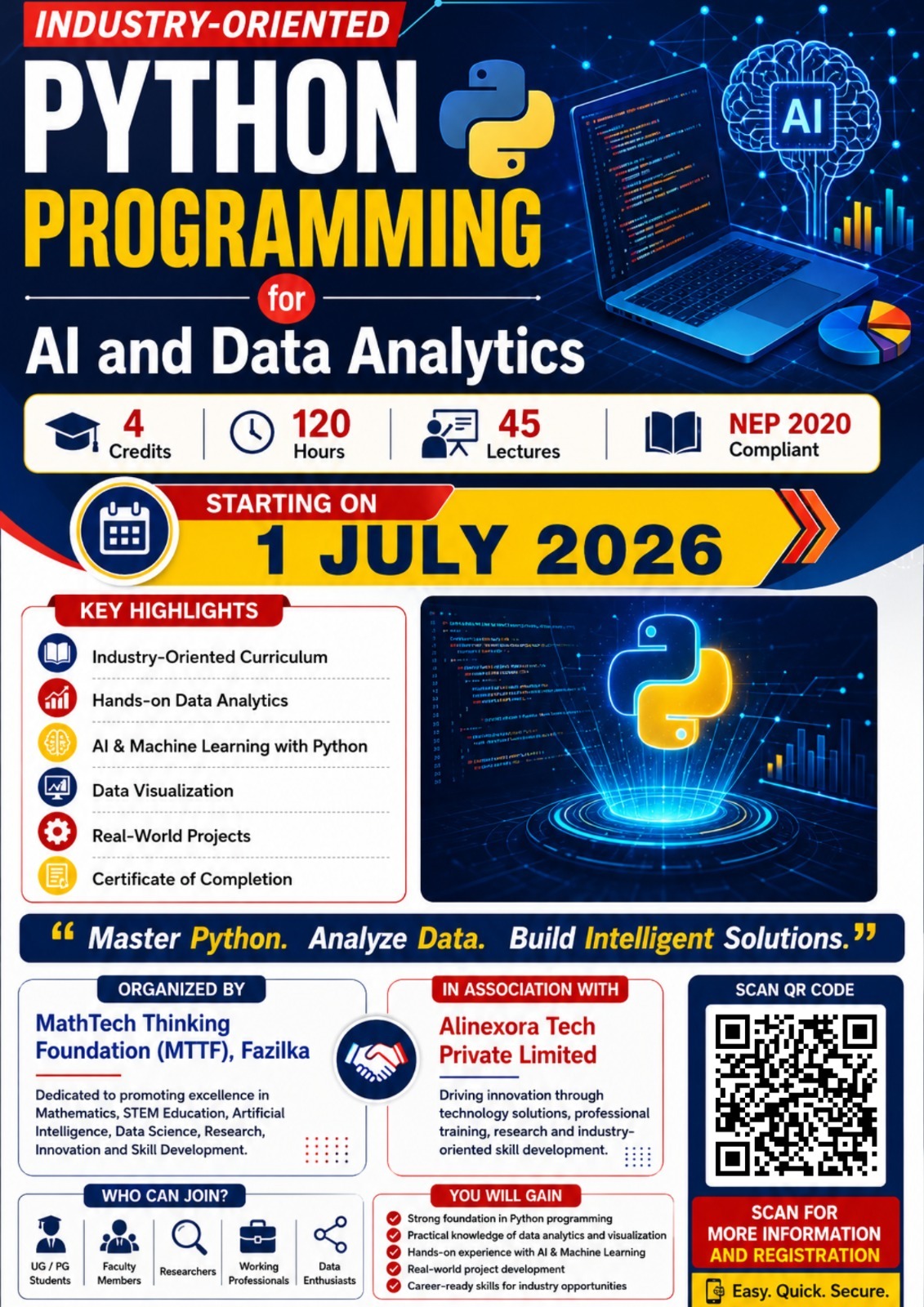
Industry-Oriented Python Programming for AI and Data Analytics
Event Date:
July 1, 2026
Event Time:
7:00 pm
Event Description
Important Dates
• Registration Opens: Open
• Registration Deadline: 30 June 2026
- Duration: 45 Days
• Workshop Dates: July 1st, 2026 To August 14th, 2026
-
Mode: Virtual (Online)
-
Seats: Limited (early registration recommended)
Registration Fee
National: 500 INR
International: 25 USD
Click here to register the programmePerks: 📜 E-Certificate | 🎥 Recordings | 🤝 Expert Interaction
Overview
About the Course
Industry-Oriented Python Programming for AI and Data Analytics is a comprehensive, skill-focused certification programme aligned with the vision and principles of the National Education Policy (NEP) 2020, emphasizing experiential learning, industry integration, multidisciplinary education, and employability enhancement. The programme comprises 120+ hours of structured learning designed to equip participants with practical and industry-relevant competencies in Python programming and data-driven technologies.
The course provides a strong foundation in Python Programming, Data Analytics, Data Visualization, Artificial Intelligence (AI), Machine Learning (ML), Predictive Modeling, and Data-Driven Decision Making. Participants will gain hands-on experience in data preprocessing, exploratory data analysis, statistical techniques, machine learning model development, and AI-powered applications using widely adopted Python libraries and tools.
Through a blend of theoretical concepts, practical exercises, real-world case studies, mini-projects, and industry-oriented assignments, learners will develop the analytical and technical skills required to solve complex business and research problems. The programme is designed to bridge the gap between academic learning and industry expectations, preparing participants for opportunities in Data Science, Artificial Intelligence, Business Analytics, Research, Software Development, FinTech, Healthcare Analytics, and other emerging technology domains.
By the end of the programme, participants will be capable of developing data-driven solutions, building machine learning models, interpreting analytical results, and applying Python-based technologies to real-world challenges across diverse sectors.
Objectives
The Industry-Oriented Python Programming for AI and Data Analytics course aims to:
- Develop strong programming skills in Python for solving real-world computational and analytical problems.
- Provide practical knowledge of data analytics and data visualization techniques using industry-standard Python libraries and tools.
- Introduce Artificial Intelligence (AI) and Machine Learning (ML) concepts and enable participants to build predictive models and intelligent applications.
- Equip learners with skills in data preprocessing, statistical analysis, and exploratory data analysis for effective data-driven decision-making.
- Enhance problem-solving and analytical abilities through hands-on exercises, case studies, assignments, and real-world datasets.
- Bridge the gap between academic learning and industry requirements by emphasizing practical implementation and industry-oriented projects.
- Develop competency in applying AI and data analytics techniques across domains such as business, healthcare, finance, engineering, education, and research.
- Promote experiential and multidisciplinary learning in alignment with the objectives of the National Education Policy (NEP) 2020.
- Prepare participants for careers and research opportunities in Data Science, Artificial Intelligence, Business Analytics, Software Development, and emerging technology sectors.
- Enable learners to design, develop, and deploy data-driven solutions using modern Python-based technologies and frameworks.
Targeted Participants
The Two-Week Workshop on “Fundamentals of Artificial Neurons and Intelligent Systems” is designed for:
- Undergraduate (UG) Students
- Postgraduate (PG) Students
- Research Scholars & Ph.D. Candidates
- Faculty Members and Academicians
- Industry Professionals and Engineers
- Data Science & AI Enthusiasts
- Software Developers and Programmers
- Researchers in Computational and Applied Sciences
- Professionals interested in Machine Learning and Intelligent Systems
- Participants seeking hands-on exposure to AI, ANN, and Computational Intelligence tools
Modules of the Programme
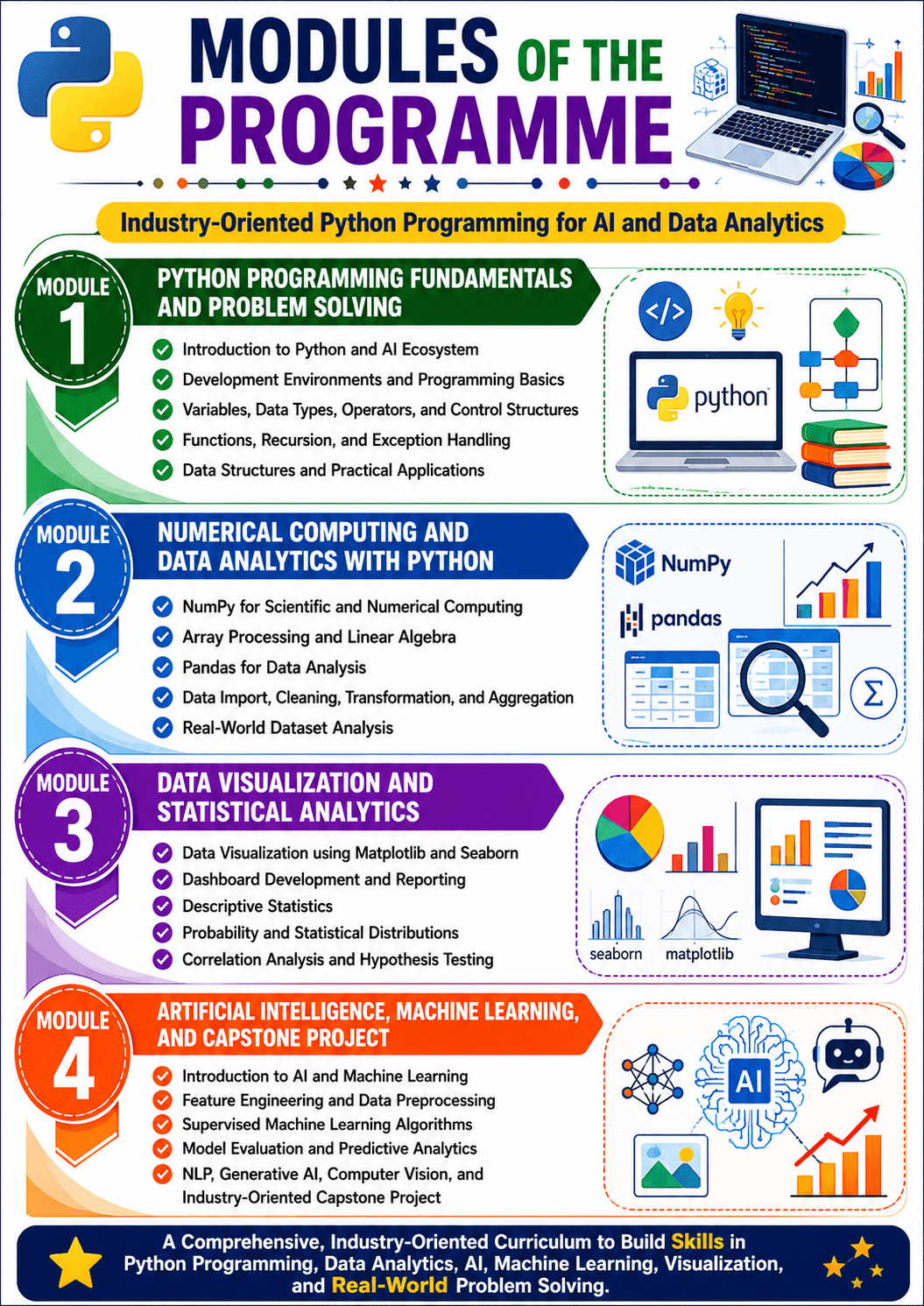
Module 1: Python Programming Fundamentals and Problem Solving
- Introduction to Python and AI Ecosystem
- Development Environments and Programming Basics
- Variables, Data Types, Operators, and Control Structures
- Functions, Recursion, and Exception Handling
- Data Structures and Practical Applications
Module 2: Numerical Computing and Data Analytics with Python
- NumPy for Scientific and Numerical Computing
- Array Processing and Linear Algebra
- Pandas for Data Analysis
- Data Import, Cleaning, Transformation, and Aggregation
- Real-World Dataset Analysis
Module 3: Data Visualization and Statistical Analytics
- Data Visualization using Matplotlib and Seaborn
- Dashboard Development and Reporting
- Descriptive Statistics
- Probability and Statistical Distributions
- Correlation Analysis and Hypothesis Testing
Module 4: Artificial Intelligence, Machine Learning, and Capstone Project
- Introduction to AI and Machine Learning
- Feature Engineering and Data Preprocessing
- Supervised Machine Learning Algorithms
- Model Evaluation and Predictive Analytics
- NLP, Generative AI, Computer Vision, and Industry-Oriented Capstone Project
Lecture-Wise Content
Lecture 1: Introduction to Python and AI Ecosystem
Lecture 2: Python Installation and Development Environments
Lecture 3: Variables, Data Types, and Input-Output Operations
Lecture 4: Operators and Expressions
Lecture 5: Type Conversion and String Manipulation
Lecture 6: Practical Session – Basic Python Programming
Lecture 7: Conditional Statements
Lecture 8: Looping Structures
Lecture 9: Functions and Scope
Lecture 10: Lambda Functions and Recursion
Lecture 11: Exception Handling
Lecture 12: Lists and List Operations
Lecture 13: Tuples and Sets
Lecture 14: Dictionaries
Lecture 15: String Processing and List Comprehensions
Lecture 16: Practical Session – Data Structure Applications
Lecture 17: Introduction to NumPy
Lecture 18: Array Operations
Lecture 19: Mathematical Functions
Lecture 20: Matrix Operations and Linear Algebra
Lecture 21: Practical Session – Numerical Computing
Lecture 22: Introduction to Pandas
Lecture 23: Data Import and Export
Lecture 24: Data Cleaning and Missing Values
Lecture 25: Data Filtering and Transformation
Lecture 26: Grouping and Aggregation
Lecture 27: Practical Session – Real Dataset Analysis
Lecture 28: Introduction to Data Visualization
Lecture 29: Visualization with Matplotlib
Lecture 30: Visualization with Seaborn
Lecture 31: Practical Session – Dashboard Development
Lecture 32: Descriptive Statistics
Lecture 33: Probability and Distributions
Lecture 34: Correlation and Hypothesis Testing
Lecture 35: Practical Statistical Analysis
Lecture 36: Introduction to Machine Learning
Lecture 37: Data Preprocessing and Feature Engineering
Lecture 38: Linear and Logistic Regression
Lecture 39: Decision Trees and K-Nearest Neighbors
Lecture 40: Model Evaluation Metrics
Lecture 41: Practical Session – Predictive Analytics
Lecture 42: Natural Language Processing and Generative AI
Lecture 43: Computer Vision and Recommendation Systems
Lecture 44: Project Planning and Proposal Development
Lecture 45: Project Presentation and Evaluation
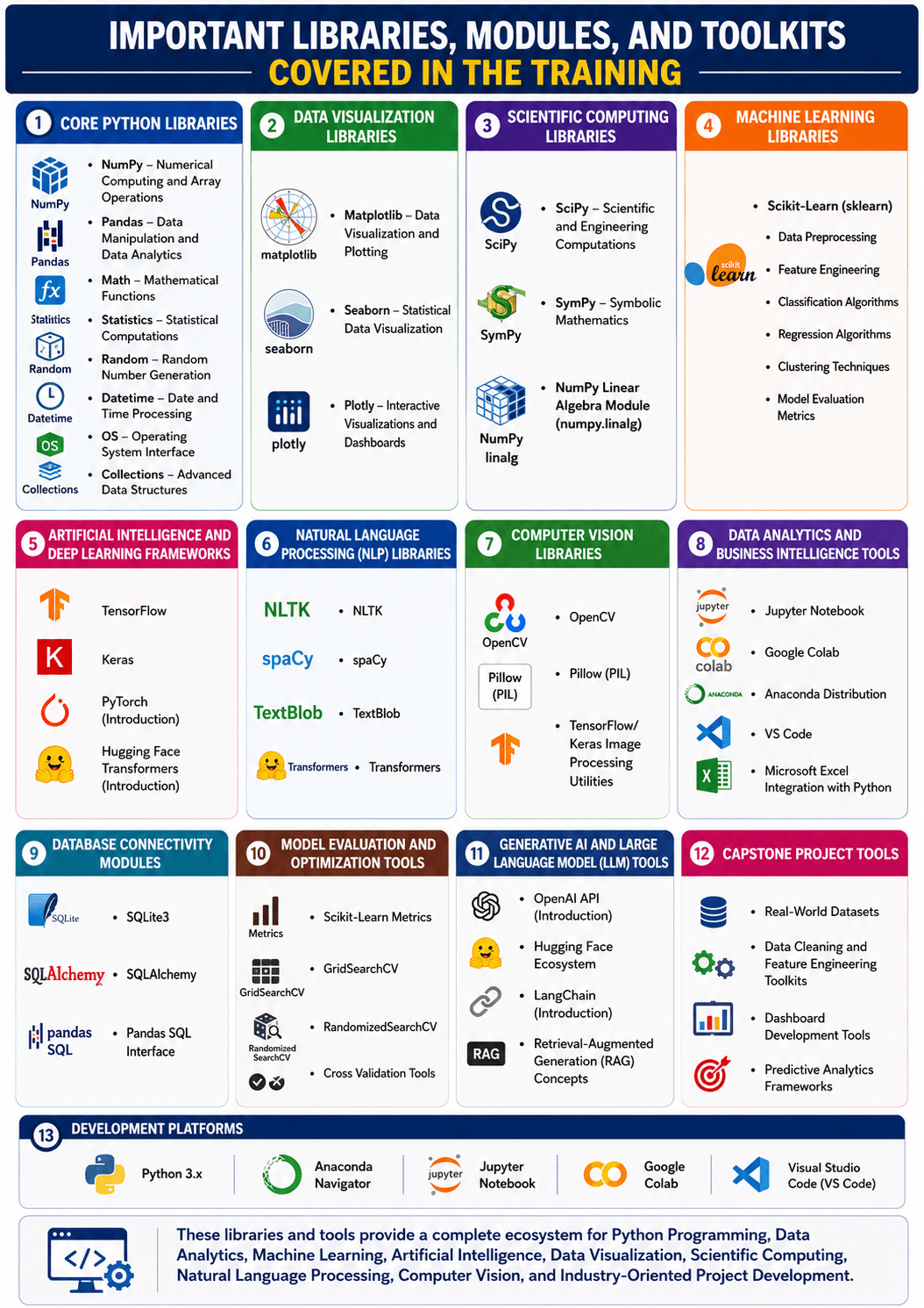
Important Libraries, Modules, and Toolkits Covered in the Training
Core Python Libraries
- NumPy – Numerical Computing and Array Operations
- Pandas – Data Manipulation and Data Analytics
- Math – Mathematical Functions
- Statistics – Statistical Computations
- Random – Random Number Generation
- Datetime – Date and Time Processing
- OS – Operating System Interface
- Collections – Advanced Data Structures
Data Visualization Libraries
- Matplotlib – Data Visualization and Plotting
- Seaborn – Statistical Data Visualization
- Plotly – Interactive Visualizations and Dashboards
Scientific Computing Libraries
- SciPy – Scientific and Engineering Computations
- SymPy – Symbolic Mathematics
- NumPy Linear Algebra Module (numpy.linalg)
Machine Learning Libraries
- Scikit-Learn (sklearn)
- Data Preprocessing
- Feature Engineering
- Classification Algorithms
- Regression Algorithms
- Clustering Techniques
- Model Evaluation Metrics
Artificial Intelligence and Deep Learning Frameworks
- TensorFlow
- Keras
- PyTorch (Introduction)
- Hugging Face Transformers (Introduction)
Natural Language Processing (NLP) Libraries
- NLTK
- spaCy
- TextBlob
- Transformers
Computer Vision Libraries
- OpenCV
- Pillow (PIL)
- TensorFlow/Keras Image Processing Utilities
Data Analytics and Business Intelligence Tools
- Jupyter Notebook
- Google Colab
- Anaconda Distribution
- VS Code
- Microsoft Excel Integration with Python
Database Connectivity Modules
- SQLite3
- SQLAlchemy
- Pandas SQL Interface
Model Evaluation and Optimization Tools
- Scikit-Learn Metrics
- GridSearchCV
- RandomizedSearchCV
- Cross Validation Tools
Generative AI and Large Language Model (LLM) Tools
- OpenAI API (Introduction)
- Hugging Face Ecosystem
- LangChain (Introduction)
- Retrieval-Augmented Generation (RAG) Concepts
Capstone Project Tools
- Real-World Datasets
- Data Cleaning and Feature Engineering Toolkits
- Dashboard Development Tools
- Predictive Analytics Frameworks
Development Platforms
- Python 3.x
- Anaconda Navigator
- Jupyter Notebook
- Google Colab
- Visual Studio Code (VS Code)
These libraries and tools provide a complete ecosystem for Python Programming, Data Analytics, Machine Learning, Artificial Intelligence, Data Visualization, Scientific Computing, Natural Language Processing, Computer Vision, and Industry-Oriented Project Development.
Speaker:
Dr. Mehar Chand is an esteemed Professor in the Department of Mathematics at Baba Farid College of Engineering and Technology, Bathinda, India. With a dedication to teaching, he imparts knowledge in various mathematical courses while actively supporting students and the broader interdisciplinary community. He has more than 15 year of teaching UG and PG classes. Under his supervision 3 scholoars awarded Ph.D degree. He has been appointed as a member of the Board of Post Graduate Studies in Mathematics at Punjabi University for the session 2022-2023. His research interests span across several areas, including fractional calculus and its applications, Mathematical Modeling, Numerical Methods, Computational Mathematics, Special functions, Hypergeometric functions, Mathematical Physics, ANN, ML, and DL. Dr. Mehar Chand’s scholarly contributions are significant, with over 70 research papers published in national and international journals, including those indexed in SCI, SCIE, and SCOPUS. Additionally, he has authored 5 Book Chapters published by Springer.Dr. Mehar Chand is an active participant in academic discourse, having delivered more than 50 invited talks, expert talks, Keynotes, and plenary talks at national and international workshops, faculty development programs, and conferences. He has also organized over 50 national and international Training Workshops, FDPs, Webinars, and Seminars.Beyond academia, Dr. Mehar Chand is the Founder and President of the MathTech Thinking Foundation (MTTF), a registered organization under Section 8 of the Companies Act 2013, Ministry of Corporate Affairs, Government of India. MTTF represents an International Scientific Association comprising esteemed experts in Science, Technology, Engineering, and Mathematics (STEM). The foundation’s initiatives include organizing conferences, workshops, symposiums, faculty development programs, and training sessions, while also providing sponsorship and technical support for such events.
Organised by:
MathTech Thinking Foundation, Punjab, India
MathTech Thinking Foundation (Udyam-Registered MSME, Section 8 Company, 12AB) is an internationally recognized organization registered under the Companies Act 2013, Ministry of Corporate Affairs, Government of India. Aligned with the UN Sustainable Development Goals, the foundation advances STEM education and research through innovation, collaboration, and inclusive knowledge sharing.
- Contact & Registration
-
WhatsApp: Faiz Ahmed (+91-70877-59319) Mehar Chand (+91-978-092-0053)