
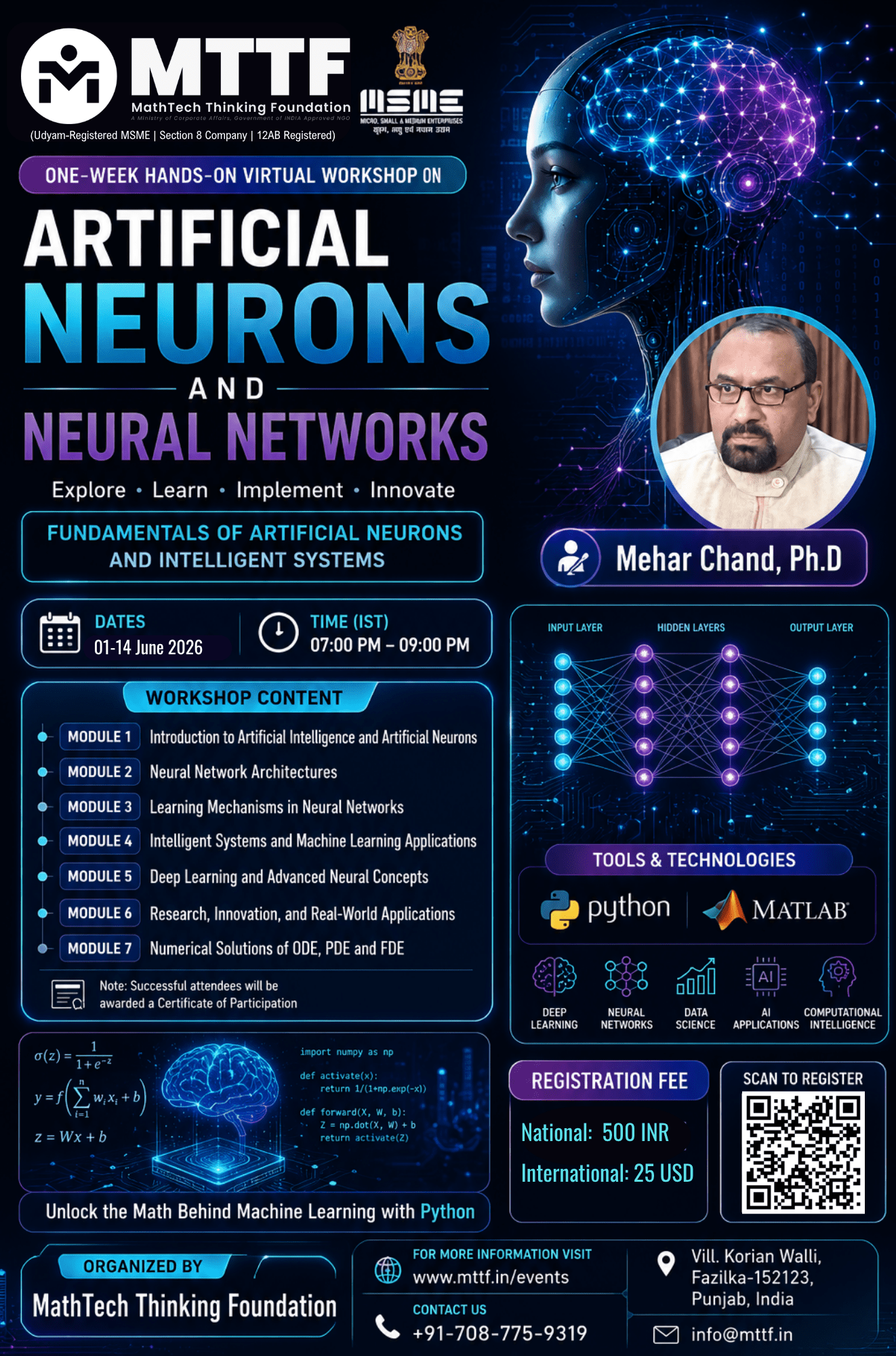
TWO-Week Workshop on Fundamentals of Artificial Neurons and Intelligent Systems
Event Date:
June 1, 2026
Event Time:
7:00 pm
Event Description
Important Dates
• Registration Opens: Open
• Registration Deadline: 01 June 2026
• Workshop Dates: 01-14 June 2026
-
Mode: Virtual (Online)
-
Seats: Limited (early registration recommended)
Registration Fee
National: 500 INR
International: 25 USD
Click here for registrationPerks: 📜 E-Certificate | 🎥 Recordings | 🤝 Expert Interaction
Overview
The Two-Week Workshop on “Fundamentals of Artificial Neurons and Intelligent Systems” is designed to provide participants with a strong foundation in Artificial Intelligence (AI), Artificial Neural Networks (ANN), and Intelligent Computing Systems. The workshop aims to bridge theoretical concepts with practical applications through expert-led sessions, demonstrations, and computational learning.
Artificial neurons are the fundamental building blocks of modern intelligent technologies inspired by the functioning of the human brain. These systems play a vital role in areas such as Machine Learning, Deep Learning, Data Science, Healthcare Analytics, Robotics, Smart Systems, Finance, Agriculture, and Predictive Modeling.
This workshop will introduce participants to:
- Fundamentals of Artificial Intelligence and Neural Networks
- Mathematical modeling of artificial neurons
- Neural network architectures and learning mechanisms
- Intelligent systems and machine learning applications
- Deep learning concepts and computational intelligence
- Real-world applications of ANN and AI technologies
- Numerical solutions of ODE, PDE, and Fractional Differential Equations (FDE)
The program is specially designed for students, research scholars, faculty members, industry professionals, and AI enthusiasts who wish to develop practical understanding and computational skills in intelligent systems.
Through interactive lectures, hands-on exposure, and application-oriented discussions, participants will gain valuable insights into emerging AI technologies and their interdisciplinary applications in science, engineering, and industry.
The workshop also emphasizes innovation, research orientation, and future technological trends, enabling participants to explore opportunities in AI-driven research, advanced computing, and intelligent automation systems.
Objectives
The primary objectives of the Two-Week Workshop on “Fundamentals of Artificial Neurons and Intelligent Systems” are:
- To provide participants with a strong foundation in Artificial Intelligence (AI) and Artificial Neural Networks (ANN).
- To understand the structure, functioning, and mathematical modeling of artificial neurons and neural systems.
- To introduce various neural network architectures, learning mechanisms, and intelligent computing techniques.
- To develop practical knowledge of Machine Learning and Deep Learning applications in real-world scenarios.
- To enhance computational and analytical skills using tools such as Python and MATLAB.
- To explore interdisciplinary applications of intelligent systems in healthcare, engineering, agriculture, finance, robotics, and smart technologies.
- To familiarize participants with modern research trends in AI, ANN, and computational intelligence.
- To encourage innovation, research aptitude, and problem-solving abilities through hands-on learning and project-based activities.
- To provide exposure to numerical methods and computational approaches for solving ODE, PDE, and Fractional Differential Equations (FDE).
- To create awareness about the role of intelligent systems in future technologies and sustainable development.
Targeted Participants
The Two-Week Workshop on “Fundamentals of Artificial Neurons and Intelligent Systems” is designed for:
- Undergraduate (UG) Students
- Postgraduate (PG) Students
- Research Scholars & Ph.D. Candidates
- Faculty Members and Academicians
- Industry Professionals and Engineers
- Data Science & AI Enthusiasts
- Software Developers and Programmers
- Researchers in Computational and Applied Sciences
- Professionals interested in Machine Learning and Intelligent Systems
- Participants seeking hands-on exposure to AI, ANN, and Computational Intelligence tools
Module-Wise Content
Module 1: Introduction to Artificial Intelligence and Artificial Neurons
Objective
To introduce the basic concepts of Artificial Intelligence and the foundational principles of artificial neurons inspired by biological neural systems.
Contents
- Introduction to Artificial Intelligence (AI)
- Evolution and Applications of AI
- Biological Neuron vs Artificial Neuron
- Components of Artificial Neurons
- Mathematical Modeling of Neurons
- Threshold Logic and Activation Mechanism
- Perceptron Model
- Introduction to Computational Intelligence
Practical Exposure
- Introduction to Python/MATLAB Environment
- Basic Simulation of Artificial Neuron Models
Module 2: Neural Network Architectures
Objective
To understand different neural network structures and their computational behavior.
Contents
- Introduction to Artificial Neural Networks (ANN)
- Single Layer Neural Networks
- Multi-Layer Neural Networks
- Feedforward Neural Networks
- Network Topology and Architecture
- Weights, Bias, and Parameters
- Activation Functions:
- Sigmoid
- Tanh
- ReLU
- Softmax
- Introduction to Deep Neural Structures
Practical Exposure
- Designing Basic Neural Network Models
- Visualization of Activation Functions
Module 3: Learning Mechanisms in Neural Networks
Objective
To understand how neural networks learn from data using optimization and training techniques.
Contents
- Supervised Learning
- Unsupervised Learning
- Training and Testing Concepts
- Error and Cost Functions
- Optimization Techniques
- Gradient Descent Method
- Backpropagation Algorithm
- Overfitting and Underfitting
- Performance Evaluation Metrics
Practical Exposure
- Training ANN Models
- Error Analysis and Model Optimization
Module 4: Intelligent Systems and Machine Learning Applications
Objective
To introduce intelligent systems and practical applications of machine learning techniques.
Contents
- Fundamentals of Machine Learning
- Intelligent Decision-Making Systems
- Data Preprocessing and Feature Engineering
- Pattern Recognition and Classification
- Predictive Modeling Techniques
- Applications in:
- Healthcare
- Agriculture
- Finance
- Smart Systems
- Cybersecurity
Practical Exposure
- Machine Learning Model Demonstration
- Data Analysis and Visualization
Module 5: Deep Learning and Advanced Neural Concepts
Objective
To provide exposure to modern deep learning frameworks and advanced neural network models.
Contents
- Introduction to Deep Learning
- Deep Neural Networks (DNN)
- Convolutional Neural Networks (CNN)
- Recurrent Neural Networks (RNN)
- Feature Extraction and Representation Learning
- Image and Speech Processing
- Natural Language Processing (NLP)
- AI Applications in Robotics and Automation
Practical Exposure
- Introduction to TensorFlow/Keras
- Simple Deep Learning Model Implementation
Module 6: Research, Innovation, and Real-World Applications
Objective
To explore emerging research trends, innovation opportunities, and interdisciplinary AI applications.
Contents
- Emerging Research Areas in AI and ANN
- AI for Sustainable Development
- Research Methodology in Computational Intelligence
- Case Studies on Intelligent Systems
- AI Startups and Innovation Ecosystem
- Ethics and Responsible AI
- Future Scope of Intelligent Technologies
Practical Exposure
- Mini Project Development
- Research Problem Identification and Discussion
Module 7: Numerical Solutions of ODE, PDE, and FDE using ANN
Objective
To introduce ANN-based numerical approaches for solving Ordinary, Partial, and Fractional Differential Equations.
Contents
- Introduction to ODE, PDE, and FDE
- Classical Numerical Methods:
- Euler Method
- Runge–Kutta Methods
- Finite Difference Method
- ANN as Universal Function Approximators
- Solving ODEs using ANN
- Solving PDEs using ANN
- Solving Fractional Differential Equations using ANN
- Error Minimization and Optimization
- Computational Modeling and Simulation
Applications
- Heat Transfer Problems
- Fluid Dynamics
- Population Models
- Fractional Kinetic Systems
- Engineering and Physical Sciences Applications
Practical Exposure
- Python/MATLAB Implementation of ANN-Based Differential Equation Solvers
- Numerical Simulation and Result Analysis
Speaker:
Dr. Mehar Chand is an esteemed Professor in the Department of Mathematics at Baba Farid College of Engineering and Technology, Bathinda, India. With a dedication to teaching, he imparts knowledge in various mathematical courses while actively supporting students and the broader interdisciplinary community. He has more than 15 year of teaching UG and PG classes. Under his supervision 3 scholoars awarded Ph.D degree. He has been appointed as a member of the Board of Post Graduate Studies in Mathematics at Punjabi University for the session 2022-2023. His research interests span across several areas, including fractional calculus and its applications, Mathematical Modeling, Numerical Methods, Computational Mathematics, Special functions, Hypergeometric functions, Mathematical Physics, ANN, ML, and DL. Dr. Mehar Chand’s scholarly contributions are significant, with over 70 research papers published in national and international journals, including those indexed in SCI, SCIE, and SCOPUS. Additionally, he has authored 5 Book Chapters published by Springer.Dr. Mehar Chand is an active participant in academic discourse, having delivered more than 50 invited talks, expert talks, Keynotes, and plenary talks at national and international workshops, faculty development programs, and conferences. He has also organized over 50 national and international Training Workshops, FDPs, Webinars, and Seminars.Beyond academia, Dr. Mehar Chand is the Founder and President of the MathTech Thinking Foundation (MTTF), a registered organization under Section 8 of the Companies Act 2013, Ministry of Corporate Affairs, Government of India. MTTF represents an International Scientific Association comprising esteemed experts in Science, Technology, Engineering, and Mathematics (STEM). The foundation’s initiatives include organizing conferences, workshops, symposiums, faculty development programs, and training sessions, while also providing sponsorship and technical support for such events.
Organised by:
MathTech Thinking Foundation, Punjab, India
MathTech Thinking Foundation (Udyam-Registered MSME, Section 8 Company, 12AB) is an internationally recognized organization registered under the Companies Act 2013, Ministry of Corporate Affairs, Government of India. Aligned with the UN Sustainable Development Goals, the foundation advances STEM education and research through innovation, collaboration, and inclusive knowledge sharing.
- Contact & Registration
-
WhatsApp: Faiz Ahmed (+91-70877-59319) Mehar Chand (+91-978-092-0053)