
International Workshop on Foundational AI and Data Science with Interdisciplinary Applications
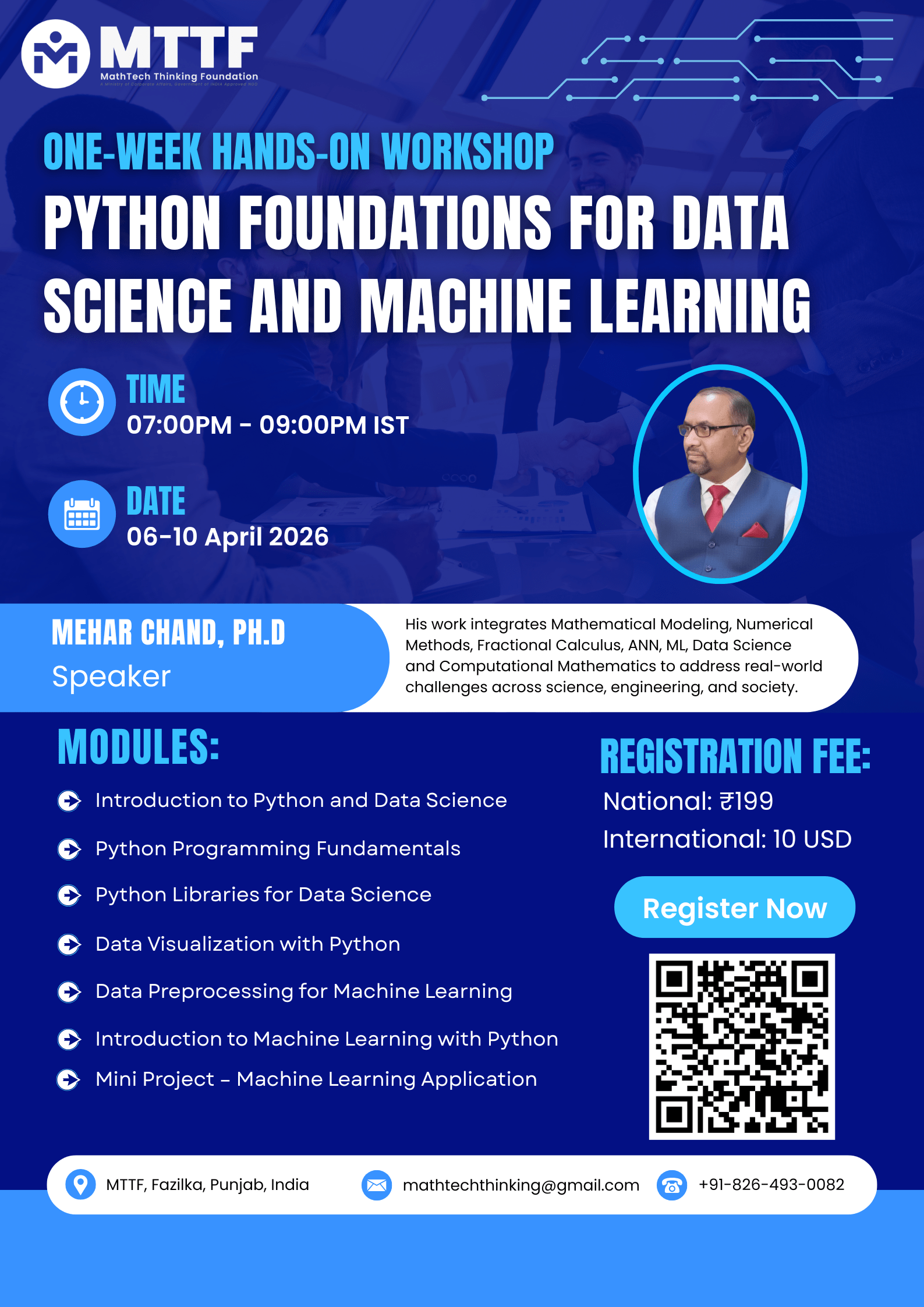
Event Date:
April 6, 2026
Event Time:
7:00 pm
Event Description
Important Dates
• Registration Opens: Open
• Registration Deadline: 05 April 2026
• Workshop Dates: 06–10 April 2026
-
Mode: Virtual (Online)
-
Seats: Limited (early registration recommended)
Registration Fee
National Participants (India): ₹199
International Participants: USD 10
Click here for registrationPerks: 📜 E-Certificate | 🎥 Recordings | 🤝 Expert Interaction
About the Workshop
The One-Week Hands-on Workshop on “Python Foundations for Data Science and Machine Learning” is designed to provide participants with a strong foundation in Python programming and its applications in data science and machine learning. Python has become one of the most widely used programming languages for data analysis, artificial intelligence, and scientific computing due to its simplicity, powerful libraries, and extensive community support. This workshop will introduce participants to the fundamentals of Python programming and gradually guide them toward practical applications in data handling, visualization, and basic machine learning techniques. Through interactive lectures and hands-on coding sessions, participants will learn how to work with important Python libraries such as NumPy, Pandas, Matplotlib, and Scikit-learn for data analysis and predictive modeling.
The workshop emphasizes practical learning, allowing participants to explore real-world datasets and develop simple machine learning models. By the end of the program, participants will have the necessary skills to perform data analysis, visualize insights, and build basic predictive models using Python. This workshop is particularly beneficial for students, researchers, faculty members, and professionals who wish to start their journey in the fields of Data Science, Machine Learning, and Artificial Intelligence. The program will include interactive sessions, coding exercises, and a mini-project, enabling participants to gain practical experience and confidence in applying Python to solve data-driven problems.
Objectives of the Workshop
- To introduce participants to the fundamentals of Python programming for data science and machine learning applications.
- To develop an understanding of data handling and analysis using Python libraries such as NumPy and Pandas.
- To provide hands-on experience in data visualization using Matplotlib and Seaborn.
- To familiarize participants with the basic concepts and workflow of machine learning.
- To train participants in data preprocessing techniques such as data cleaning, feature scaling, and encoding.
- To enable participants to implement basic machine learning models using Scikit-learn.
- To enhance participants’ ability to analyze datasets and interpret results effectively.
- To provide practical exposure through hands-on exercises and mini-projects using real-world datasets.
Targeted Participants
The workshop is intended for:
- Undergraduate and Postgraduate Students from disciplines such as Computer Science, Mathematics, Statistics, Engineering, and Data Science.
- Research Scholars interested in learning Python for data analysis and machine learning applications.
- Faculty Members and Academicians who wish to integrate Python-based data science tools into teaching and research.
- Industry Professionals and Practitioners seeking to enhance their skills in data analysis and machine learning.
- Beginners and Enthusiasts who want to start their journey in Data Science, Artificial Intelligence, and Machine Learning using Python.
Content:
Module 1: Introduction to Python and Data Science
Topics
- Overview of Python programming
- Why Python for Data Science and Machine Learning
- Installation of Python, Anaconda, and Jupyter Notebook
- Introduction to Jupyter Notebook interface
- Basic Python syntax
- Variables, data types, and operators
Hands-on
- Running Python in Jupyter Notebook
- Simple programs and calculations
Learning Outcome
Participants will understand the basic Python environment and programming structure.
Module 2: Python Programming Fundamentals
Topics
- Conditional statements (if, else, elif)
- Loops (for loop, while loop)
- Functions in Python
- Lists, tuples, sets, and dictionaries
- Basic input and output operations
Hands-on
- Writing Python programs
- Creating simple functions
- Working with lists and dictionaries
Learning Outcome
Participants will learn core programming concepts required for data analysis.
Module 3: Python Libraries for Data Science
Topics
- Introduction to NumPy
- Numerical computing using arrays
- Introduction to Pandas
- Data structures: Series and DataFrame
- Data loading from CSV/Excel files
Hands-on
- Data manipulation using Pandas
- Basic statistical operations
Learning Outcome
Participants will understand data handling and preprocessing using Python libraries.
Module 4: Data Visualization with Python
Topics
- Importance of data visualization
- Introduction to Matplotlib
- Introduction to Seaborn
- Creating line plots, bar charts, histograms, and scatter plots
Hands-on
- Visualizing real datasets
- Creating customized plots
Learning Outcome
Participants will learn how to visualize and interpret data effectively.
Module 5: Data Preprocessing for Machine Learning
Topics
- Data cleaning and handling missing values
- Encoding categorical variables
- Feature scaling (Normalization and Standardization)
- Train-test split
Hands-on
- Preparing datasets for machine learning models
Learning Outcome
Participants will understand how to prepare datasets for machine learning tasks.
Module 6: Introduction to Machine Learning with Python
Topics
- Overview of Machine Learning
- Types of Machine Learning (Supervised, Unsupervised)
- Introduction to Scikit-learn
- Regression and classification concepts
Hands-on
- Implementing a simple Linear Regression model
- Implementing a classification model
Learning Outcome
Participants will understand basic machine learning workflow in Python.
Module 7: Mini Project – Machine Learning Application
Topics
- Building a complete ML pipeline
- Model training and evaluation
- Accuracy, confusion matrix, and model validation
Hands-on Project
Example projects:
- Crop Recommendation System
- Student Performance Prediction
- House Price Prediction
Speaker:
Dr. Mehar Chand is an esteemed Professor in the Department of Mathematics at Baba Farid College of Engineering and Technology, Bathinda, India. With a dedication to teaching, he imparts knowledge in various mathematical courses while actively supporting students and the broader interdisciplinary community. He has more than 15 year of teaching UG and PG classes. Under his supervision 3 scholoars awarded Ph.D degree. He has been appointed as a member of the Board of Post Graduate Studies in Mathematics at Punjabi University for the session 2022-2023. His research interests span across several areas, including fractional calculus and its applications, Mathematical Modeling, Numerical Methods, Computational Mathematics, Special functions, Hypergeometric functions, Mathematical Physics, ANN, ML, and DL. Dr. Mehar Chand’s scholarly contributions are significant, with over 70 research papers published in national and international journals, including those indexed in SCI, SCIE, and SCOPUS. Additionally, he has authored 5 Book Chapters published by Springer.Dr. Mehar Chand is an active participant in academic discourse, having delivered more than 50 invited talks, expert talks, Keynotes, and plenary talks at national and international workshops, faculty development programs, and conferences. He has also organized over 50 national and international Training Workshops, FDPs, Webinars, and Seminars.Beyond academia, Dr. Mehar Chand is the Founder and President of the MathTech Thinking Foundation (MTTF), a registered organization under Section 8 of the Companies Act 2013, Ministry of Corporate Affairs, Government of India. MTTF represents an International Scientific Association comprising esteemed experts in Science, Technology, Engineering, and Mathematics (STEM). The foundation’s initiatives include organizing conferences, workshops, symposiums, faculty development programs, and training sessions, while also providing sponsorship and technical support for such events.
Organised by:
MathTech Thinking Foundation, Punjab, India
MathTech Thinking Foundation (Udyam-Registered MSME, Section 8 Company, 12AB) is an internationally recognized organization registered under the Companies Act 2013, Ministry of Corporate Affairs, Government of India. Aligned with the UN Sustainable Development Goals, the foundation advances STEM education and research through innovation, collaboration, and inclusive knowledge sharing.
- Contact & Registration
-
WhatsApp: +91-978-092-0053