
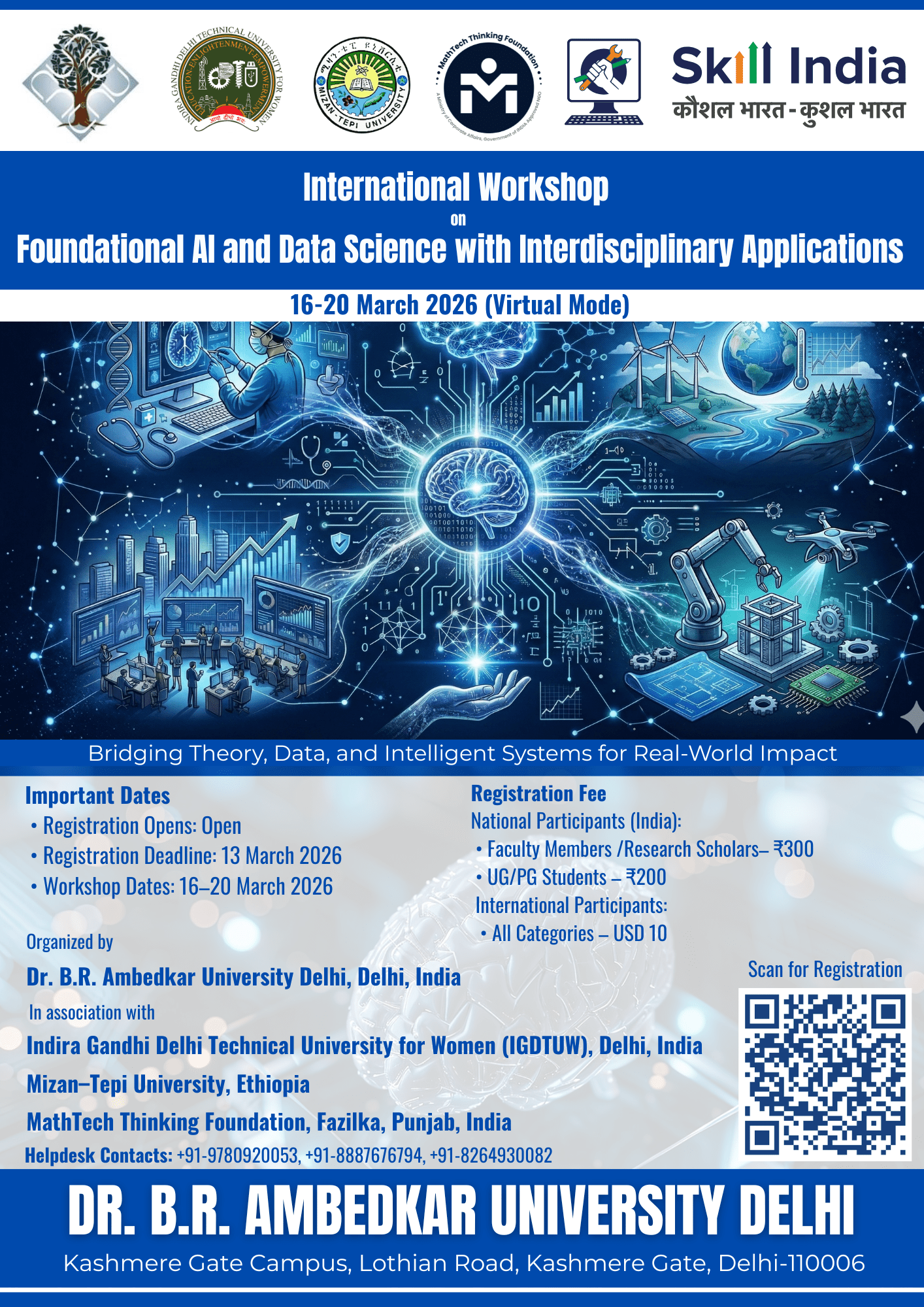
International Workshop on Foundational AI and Data Science with Interdisciplinary Applications
Event Date:
March 16, 2026
Event Time:
11:00 am
Important Dates
• Registration Opens: Open
• Registration Deadline: 13 March 2026
• Workshop Dates: 16–20 March 2026
-
Mode: Virtual (Online)
-
Seats: Limited (early registration recommended)
Registration Fee
National Participants (India):
• Faculty Members /Research Scholars– ₹300
• UG/PG Students – ₹200
International Participants:
• All Categories – USD 10
Click here to RegisterAbout the Workshop
Artificial Intelligence (AI) and Data Science are rapidly transforming the current research, governance, industry, and society, making it essential that their development is aligned with sustainability, ethics, and inclusive growth. The International Workshop on Foundational AI and Data Science with Interdisciplinary Applications is conceived in alignment with the UN Sustainable Development Goals (SDGs) and India’s Viksit Bharat @2047 Vision, which emphasize technology-led development, innovation, human capital formation, and responsible digital transformation. By focusing on foundational AI and data-driven methodologies through an interdisciplinary lens, the workshop addresses key priorities such as quality education (SDG 4), innovation and infrastructure (SDG 9), climate action (SDG 13), reduced inequalities (SDG 10), and strong institutions (SDG 16), while fostering partnerships for sustainable development (SDG 17). The workshop provides a collaborative academic platform for researchers, educators, industry professionals, and policymakers to explore sustainable, ethical, and socially responsible AI systems that support data-driven decision-making and long-term societal impact. In doing so, it contributes to building a globally competitive, innovation-driven, and inclusive knowledge ecosystem that advances India’s vision of becoming a developed nation by 2047 while supporting global sustainability objectives.
Workshop Objectives
The primary objectives of the workshop are:
- To provide a strong conceptual understanding of Foundational AI and Data Science.
- To explore sustainability principles in the design, deployment, and governance of AI systems.
- To promote interdisciplinary research and applications of AI and Data Science.
- To discuss ethical, legal, and societal implications of AI technologies.
- To encourage collaboration between academia, industry, and policy stakeholders.
- To build research capacity among faculty members, research scholars, and postgraduate students.
- To align AI and Data Science research with Sustainable Development Goals (SDGs).
Targeted Participants
The workshop is intended for:
- Faculty members from universities and colleges
- Research scholars (Ph.D. / Postdoctoral Fellows)
- Postgraduate and advanced undergraduate students
- Data scientists and AI professionals
- Industry researchers and practitioners
- Policymakers and stakeholders in technology and sustainability
Themes and Sub-Themes
The workshop will cover, but not be limited to, the following themes:
- Foundations of Artificial Intelligence and Machine Learning
- Mathematical and Statistical Foundations of Data Science
- Sustainable and Energy-Efficient AI Models
- Responsible, Ethical, and Trustworthy AI
- Explainable and Interpretable AI
- AI for Climate Change, Environment, and Sustainability
- AI in Healthcare, Education, and Social Sciences
- Interdisciplinary Data Analytics and Decision Support Systems
- AI Governance, Policy, and Regulatory Frameworks
- Future Directions in Foundational and Sustainable AI
Structure and Methodology
The workshop will be conducted through a combination of:
- Expert keynote and invited lectures
- Technical sessions and tutorials
- Hands-on demonstrations and practical sessions
- Panel discussions and interactive forums
- Research presentations and idea exchanges
Each day will focus on a specific thematic cluster, ensuring a balanced mix of theory, practice, and interdisciplinary dialogue.
Expected Outcomes
The expected outcomes of the workshop include:
- Enhanced understanding of sustainable and foundational AI concepts
- Strengthened interdisciplinary research networks
- Identification of collaborative research opportunities
- Capacity building among young researchers and students
- Policy and practice recommendations for sustainable AI adoption
Daywise Content:
Day 1: Foundations of AI and Data Science
Main Session Theme: Building core conceptual and mathematical/statistical understanding Integrated Activities:
- Keynote lecture: “Foundations of Artificial Intelligence, Machine Learning, and Data Science: Principles and Evolution”
- Technical deep-dive: Supervised/unsupervised learning, neural architectures, probability/statistics essentials for DS
- Hands-on: Guided Python tutorial implementing basic ML models (e.g., regression, clustering) using scikit-learn on sample datasets
- Interactive: Group Q&A and short participant sharing on how these foundations apply to their domains (linking to SDGs like quality education and innovation)
Outcome: Strong baseline knowledge; participants ready for advanced/sustainable topics.
Day 2: Sustainable and Energy-Efficient AI
Main Session Theme: Sustainability principles in AI design, training, and environmental applications Integrated Activities:
- Keynote lecture: “Green AI and Sustainable Foundational Models: Techniques and Real-World Impact”
- Technical deep-dive: Model compression, quantization, efficient architectures, federated learning, carbon-aware computing
- Hands-on: Practical demo using tools to measure/train lightweight models; experiment with energy-efficient inference on climate/environment datasets (e.g., renewable energy prediction, SDG 13 linkage)
- Interactive: Panel-style discussion on balancing computational demands with planetary boundaries, with inputs from academia/industry
Outcome: Practical skills in designing eco-friendly AI systems and awareness of climate-action intersections.
Day 3: Responsible, Ethical, and Trustworthy AI
Main Session Theme: Ethics, fairness, explainability, and societal implications Integrated Activities:
- Keynote lecture: “Towards Trustworthy AI: Ethics, Bias Mitigation, and Explainability in Foundation Models”
- Technical deep-dive: Fairness metrics, bias auditing, interpretability techniques (LIME, SHAP, attention visualization), robustness
- Hands-on: Interactive auditing exercise—participants evaluate a pre-trained model for biases/explain decisions on diverse datasets (social inclusion focus, SDG 10)
- Interactive: Case-study discussions and ethical dilemma forum (privacy, equity, job impacts)
Outcome: Tools and mindset for responsible AI development and deployment.
Day 4: Interdisciplinary Applications and Decision Support
Main Session Theme: AI/Data Science in healthcare, education, social sciences, and cross-domain analytics Integrated Activities:
- Keynote lecture: “Interdisciplinary AI: Driving Impact in Healthcare, Education, Social Good, and Beyond”
- Technical deep-dive: Domain-adapted models, multimodal data fusion, decision-support systems (e.g., predictive analytics for public health/SDG 3, personalized learning/SDG 4)
- Hands-on: End-to-end pipeline tutorial—building simple interdisciplinary applications (e.g., sentiment analysis for social sciences, health outcome prediction dashboard)
- Interactive: Participant-led idea exchange—short pitches of their research/application ideas, with peer/expert feedback
Outcome: Inspiration and concrete examples for applying AI/DS across fields, sparking collaborations.
Day 5: AI Governance, Policy, and Future Directions
Main Session Theme: Governance frameworks, policy alignment, partnerships, and emerging trends Integrated Activities:
- Keynote lecture: “Governing Sustainable AI: Policies, Regulations, and Pathways to Viksit Bharat @2047 & Global SDGs”
- Technical deep-dive: Global/regional frameworks (e.g., EU AI Act influences, UNESCO ethics, India-specific policies), risk assessment, inclusive governance
- Interactive panel: Multi-stakeholder discussion (academia, industry, policymakers) on fostering partnerships (SDG 17) and responsible adoption
- Closing session: Future trends (agentic/multimodal AI, long-term societal impact); collaborative opportunity brainstorming; policy recommendation synthesis; certificate distribution and networking
Outcome: Actionable insights on governance, strengthened networks, and recommendations for sustainable AI.
Tentative Resource Persons
- Prof. Gaurav Bhatnagar, IIT Jodhpur
- Prof. Sanjeev Malik, IIT Roorkee, Roorkee.
- Prof. Mahipal Jadeja: Department of Computer Science & Engineering, Malaviya National Institute of Technology (MNIT), Jaipur
- Prof. Biswan Senapati: COEUSS LLC Aurora, IL USA
- Prof. Ihtiram Raza Khan: Department of CSE, SEST Jamia Hamdard University, New Delhi
- Prof. Chaitanya Singla: Department of Computer Science and Engineering, Chandigarh Engineering College, Chandigarh Group of Colleges,Mohali, Punjab
- Prof. Upinder Kaur: Department of Computer Science and Engineering, Akal University, Bathinda
This workshop is ideal for individuals seeking to build strong conceptual and practical expertise in Artificial Intelligence and Machine Learning.
Organizing Institutions:
The workshop is jointly organized by:
B. R. Ambedkar University Delhi, Delhi
Dr. B. R. Ambedkar University Delhi (AUD) is a public, multi-campus university established by the Government of NCT of Delhi in 2007 and notified in 2008. It offers undergraduate, postgraduate, and research programmes in the social sciences and humanities, guided by Dr. B. R. Ambedkar’s vision of equality, social justice, and academic excellence, while fostering an inclusive, humanistic, and collaborative institutional culture.
Indira Gandhi Delhi Technical University for Women (IGDTUW), Delhi
Indira Gandhi Delhi Technical University for Women (IGDTUW) is a public, non-affiliating university established by the Government of NCT of Delhi in 2013 to promote education, research, innovation, and entrepreneurship among women, with a strong focus on engineering, technology, applied sciences, and architecture. Evolving from the erstwhile Indira Gandhi Institute of Technology (established in 1998), IGDTUW has grown rapidly, offering undergraduate, postgraduate, and doctoral programmes, fostering high-quality teaching, competitive research, industry-sponsored projects, and innovation through its incubation centre Anveshan.
Mizan-Tepi University, Ethiopia
Mizan-Tepi University (MTU), Tepi Campus, Ethiopia is one of the government institutions of higher education, which is established in 1999 E.C/ 2007 G.C. The University is found in Southern Nation Nationalities Regional State, 583 km. away from the capital Addis Ababa. The mission of MTU is geared towards contributing substantially to the development of the nation by preserving and utilizing natural resources and cultural values through the provision of relevant and quality education, active participation in research, technology transfer and community services. The campus has two colleges and one school. The MTU has signed MoU with MTTF on July 8, 2021 for one year.
MathTech Thinking Foundation, Punjab, India
MathTech Thinking Foundation (Udyam-Registered MSME, Section 8 Company, 12AB) is an internationally recognized organization registered under the Companies Act 2013, Ministry of Corporate Affairs, Government of India. Aligned with the UN Sustainable Development Goals, the foundation advances STEM education and research through innovation, collaboration, and inclusive knowledge sharing.
- Contact & Registration
-
WhatsApp: +91-978-092-0053