- Climate Change Impacts and Risk Assessment
- Renewable Energy and Clean Technology Solutions
- Climate Adaptation, Resilience, and Mitigation Strategies
- Sustainable Resource Management and Circular Economy

Two-Week National Workshop on Sustainable India 2030: Climate, Education, Health, and Economic Resilience
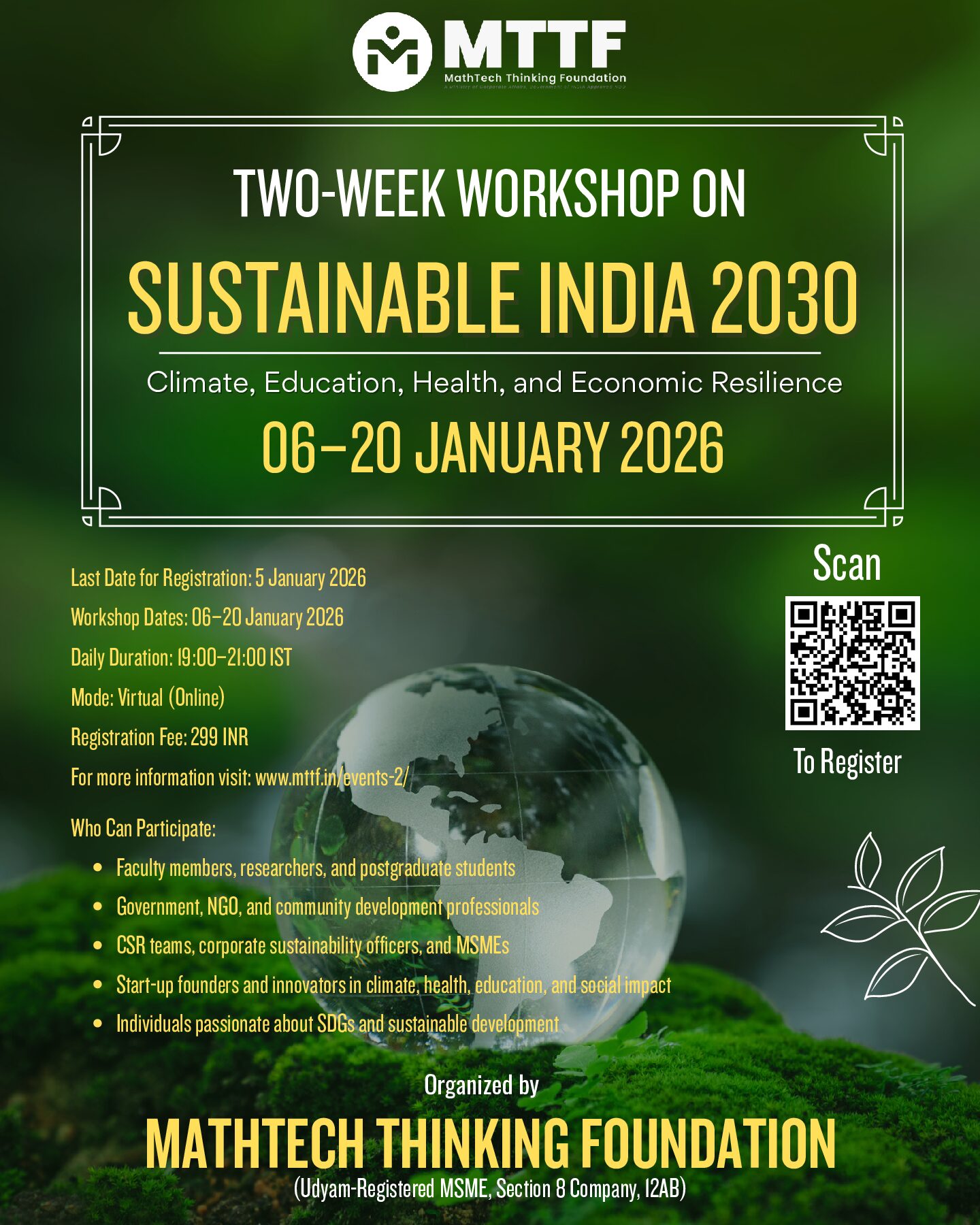
Important Dates
• Registration Deadline: 5 January 2026
• Workshop Duration: 06–20 January 2026
• Daily Session Time: 19:00–21:00 IST
Registration
• Participation is open exclusively to Indian citizens.
• Interested participants must complete the online registration process before the deadline.
• Registration Fee: 299 INR.
About the Workshop
The Two-Week Online Workshop on Sustainable India 2030: Climate, Education, Health, and Economic Resilience is designed to strengthen the capacity of participants to engage with India’s Sustainable Development Goals (SDGs) in a practical, action-oriented manner. Organized by MathTech Thinking Foundation (Udyam-Registered MSME, Section 8 Company), the workshop brings together experts, practitioners, educators, and learners to explore multidimensional challenges and opportunities shaping India’s development agenda.
The program provides a structured blend of thematic sessions, hands-on digital activities, policy discussions, and collaborative problem-solving through an SDG Innovation Lab. Participants will gain exposure to climate resilience frameworks, education transformation strategies, public health systems, and inclusive economic models, while also learning to use data, technology, and community engagement tools. By the end of the workshop, participants will be equipped with the knowledge, skills, and digital resources needed to contribute effectively to sustainable and inclusive growth aligned with India’s 2030 vision.
Objectives
• Build knowledge and awareness of India’s SDG priorities across climate, education, health, and economic resilience.
• Equip participants with practical tools for SDG planning, monitoring, and implementation in an online environment.
• Develop digital competencies in data analysis, dashboarding, community engagement, and sustainability-focused innovation.
• Encourage interdisciplinary thinking through expert sessions, case discussions, and collaborative activities.
• Enable participants to design actionable, scalable solutions through the SDG Innovation Lab.
Expected Outcomes
• Enhanced understanding of SDG-aligned strategies in climate, education, health, and economic resilience.
• Ability to use digital tools for SDG data analysis, monitoring, and solution design.
• Development of practical, team-based prototypes through the SDG Innovation Lab.
• Strengthened capacity for policy formulation, community engagement, and sustainable project planning.
• Improved readiness to contribute to institutional, regional, and national SDG initiatives.
Who Can Participate
• Faculty members, researchers, and postgraduate students
• Government officials, NGO professionals, and community workers
• Corporate CSR teams and sustainability practitioners
• MSMEs, start-up founders, and innovators
• Individuals interested in sustainable development and SDGs
Content
WEEK 1: FOUNDATIONS AND SECTORAL DEEP DIVES
Day 1: Inauguration and India’s SDG Vision
• Inaugural session, keynote on India’s SDG trajectory
• Overview of SDG indicators, NITI Aayog SDG Index, and India’s 2030 priorities
• Panel: Institutional and local governance roles in SDG implementation
• Activity: SDG literacy and mapping exercise
Day 2: Climate Action and Environmental Sustainability
• Climate change science contextualized for India
• India’s commitments: NDCs, Mission LiFE, Green Hydrogen, renewable targets
• Workshop: Designing local-level climate action plans
• Practical module: Carbon footprint measurement and reporting
Day 3: Water, Energy, and Urban Sustainability
• Water security and watershed management
• Clean energy transitions and green infrastructure
• Sustainable urban development: smart cities, mobility, waste management
• Case studies: Pune, Indore, Bengaluru sustainability practices
Day 4: Education for Sustainable Development
• NEP 2020 and SDG-aligned education reforms
• Digital learning ecosystems and inclusive access
• Skill development for green jobs
• Hands-on: Integrating SDGs into lesson plans, curriculum design
Day 5: Health and Well-being
• Public health systems and SDG 3
• Emerging threats: AMR, pandemics, climate-health nexus
• Digital health innovations, telemedicine, Ayushman Bharat
• Simulation: Designing a community health awareness model
Day 6: Inclusive Economic Growth and Livelihoods
• SDG-linked entrepreneurship, MSME development, rural economic resilience
• Financial inclusion, digital public infrastructure, India Stack
• Workshop: Creating models for sustainable rural/urban livelihoods
Day 7: Field Visit / Case Exposure
Choose domain-based exposure:
• Climate action site (solar plant, waste-to-energy facility)
• Model educational institution
• Community health center
• MSME cluster or rural start-up ecosystem
WEEK 2: INTEGRATION, TECHNOLOGY, AND SOLUTION BUILDING
Day 8: Data, AI, and Technology for SDGs
• Using data analytics, GIS, and AI for climate, health, education, and economic planning
• SDG indicator dashboards and digital monitoring
• Hands-on: Building micro-dashboards using open-source tools
Day 9: Policy, Governance, and Financing for SDG Implementation
• Public policy design cycles and evidence-based planning
• Budgeting, public finance, CSR, and SDG-linked proposals
• Writing proposals for national funding: ANRF, DST, AICTE, ICSSR
• Group activity: Draft an SDG policy brief
Day 10: Community Engagement and Behavioural Change
• Behavioural economics and social mobilization
• Localizing SDGs at district and panchayat levels
• Tools: PRA methods, stakeholder analysis, gender inclusion
• Activity: SDG community action simulation
Day 11: Innovation, Start-up Models, and Green Technologies
• Innovations in climate-tech, ed-tech, health-tech, and agri-tech
• Mentoring on idea development for sustainable enterprises
• Demo sessions: IoT for sustainability, low-cost solutions
Day 12: Climate action and environmental sustainability
Day 13: Presentation, Validation, and Expert Review
• Teams present solutions to expert panel
• Feedback and refinement sessions
• Establish pathways for pilot implementation
Day 14: Closing Ceremony and Action Plan
• Consolidation of learning
• Release of workshop recommendations report
• Certificates distribution
• MoU drafting for continued collaboration among stakeholders
Organized by
MathTech Thinking Foundation (Udyam-Registered MSME, Section 8 Company)